


Jieun LEE
Composer & Producer
Jieun Lee composes large-scale music theatre works in which narration emerges from musical structure and sound.


Jieun Lee is a composer and artist whose work explores the relationship between people, nature, and the ocean through music. Her recent projects focus on the climate crisis, marine environments, and Ocean Literacy through opera, film, and interdisciplinary art. She participates in UN Ocean Decade Endorsed Projects and UNESCO-IOC Blue Thread Endorsed Projects, connecting art, science, and society.
ARTIST BIOGRAPHY
Ji Eun Lee (1974~) is a composer whose work centers on large-scale musical forms, particularly opera and oratorio, through which she explores the relationships between music and narrative, human memory, and contemporary social and ecological questions. Drawing on her musical experience in Korea and Germany, she has developed an individual musical language that brings together the traditions of Western classical music, contemporary approaches to sound, Korean sensibility, and the narrative immediacy of musical theatre and popular music.
In Lee’s music, narrative is not a story imposed upon music but something that emerges through musical structure and time. Vocal lines function not merely to express character psychology, but as structural axes that shape the temporal progression of the music, while orchestration creates breath, space, density, and continuity. Repetition and suspension serve as formal devices through which memory accumulates and time expands. In this way, music moves beyond its role as a background to drama and becomes a language through which narrative itself is constructed.
Her earlier works have explored historical violence, loss, and memory. Through works such as the opera Time Cobweb and the oratorio Martyres, she has examined how individual and collective experiences are remembered and reconstructed through time. This inquiry extends into OPERA KALEA – BUTALSORO, where her artistic concerns expand toward questions of humanity and nature, survival and displacement, climate crisis, and ecological ethics. In KALEA – BUTALSORO, the realities of sea-level rise and climate-induced displacement are transformed into a mythic narrative, with the ocean presented not simply as a setting but as an active presence carrying memory, emotion, and the conditions of survival. Non-verbal elements such as waves, breath, and silence are incorporated into the musical structure, allowing music to become not merely a means of depicting a scene, but an experiential space in itself.
Since 2025, Lee has been involved in officially endorsed projects of the UN Ocean Decade and, since 2026, in projects officially recognized through the UNESCO-IOC Blue Thread initiative. As an artist member of ODTIF (Ocean Data Tapestry International Forum), she collaborates with scientists, educators, and policy experts. Through presentations at international forums and academic events on Ocean Literacy and the marine environment, she explores how scientific knowledge and data can be reinterpreted through artistic language and transformed into sensory experience. Her ongoing practice investigates the potential of art as a language of empathy and communication that can reshape how we perceive the relationship between humanity and the ocean. Through new opera and oratorio projects centered on the ocean, she continues to expand her creative practice at the intersection of art, science, education, and society.
For Lee, music is not merely a means of explaining or communicating something. It is a space through which we sense and remember the world, reconsider our own position, and reflect on our relationships with others and with the world around us. Through opera and large-scale musical forms, she brings contemporary social and ecological questions into the structures of musical time and form, continually seeking new relationships between art and life, and between humanity and nature.
아티스트 프로필
이지은(1974~)은 오페라와 오라토리오를 비롯한 대규모 음악 형식을 통해 음악과 서사, 인간의 기억과 사회·생태적 질문을 탐구해 온 작곡가이다. 한국과 독일에서의 음악적 경험을 바탕으로 서양 클래식의 전통과 현대적 음향, 한국적 정서와 동시대적 서사 감각을 결합하며 자신만의 음악 세계를 구축해 왔다.
그녀의 음악에서 서사는 음악을 설명하는 이야기가 아니라 음악의 시간과 구조 속에서 생성되는 경험이다. 오페라 시간거미줄과 오라토리오 Martyres를 통해 기억과 상실, 역사적 폭력의 문제를 다루었으며, 오페라 KALEA – BUTALSORO에서는 인간과 자연, 기후 위기와 이주, 생존과 생태적 윤리의 문제로 시선을 확장하였다. 바다와 자연의 움직임은 그의 음악 안에서 하나의 풍경을 넘어 기억과 감각, 생명의 서사를 만들어내는 존재로 작동한다.
이지은은 작품을 무대에 한정하지 않고 지속적으로 새로운 음악을 창작하고 음반으로 발표하며 자신의 음악 세계를 확장해 왔다. 다양한 기악 작품과 해양을 주제로 한 음악을 비롯해 꾸준히 디지털 앨범을 발매하고 있으며, 최근에는 NAXOS Music을 통한 글로벌 디지털 발매로 활동 영역을 넓히고 있다.
2025년부터 UN Ocean Decade 공식 승인 프로젝트에 참여하고 있으며, UNESCO-IOC Blue Thread 공식 인증 프로젝트인 ODTIF(Ocean Data Tapestry International Forum)의 예술가 멤버로 활동하고 있다. 과학자, 교육자, 정책 전문가들과의 협업을 통해 해양과학의 지식과 데이터를 예술적 언어로 재해석하고, 과학적 사실을 감각적 경험과 공감의 영역으로 확장하는 작업을 이어가고 있다.
음악을 통해 보이지 않는 세계를 감각하게 하고, 인간과 자연의 관계를 다시 바라보게 하는 것. 그것이 이지은의 창작이 향하는 하나의 방향이며, 그는 오페라와 오라토리오, 그리고 지속적인 음반 발매를 통해 그 세계를 현재의 음악으로 끊임없이 확장해 가고 있다.

Welcome to The Opera KALEA - BUTALSORO composer Jieun LEE, 오페라 부탈소로의 항해자들을 위한 안내서 작곡가 이지은

(fyc eng) Best Opera Recording / Jieun LEE : Kalea Butalsoro (Live) For Your GRAMMY® Consideration
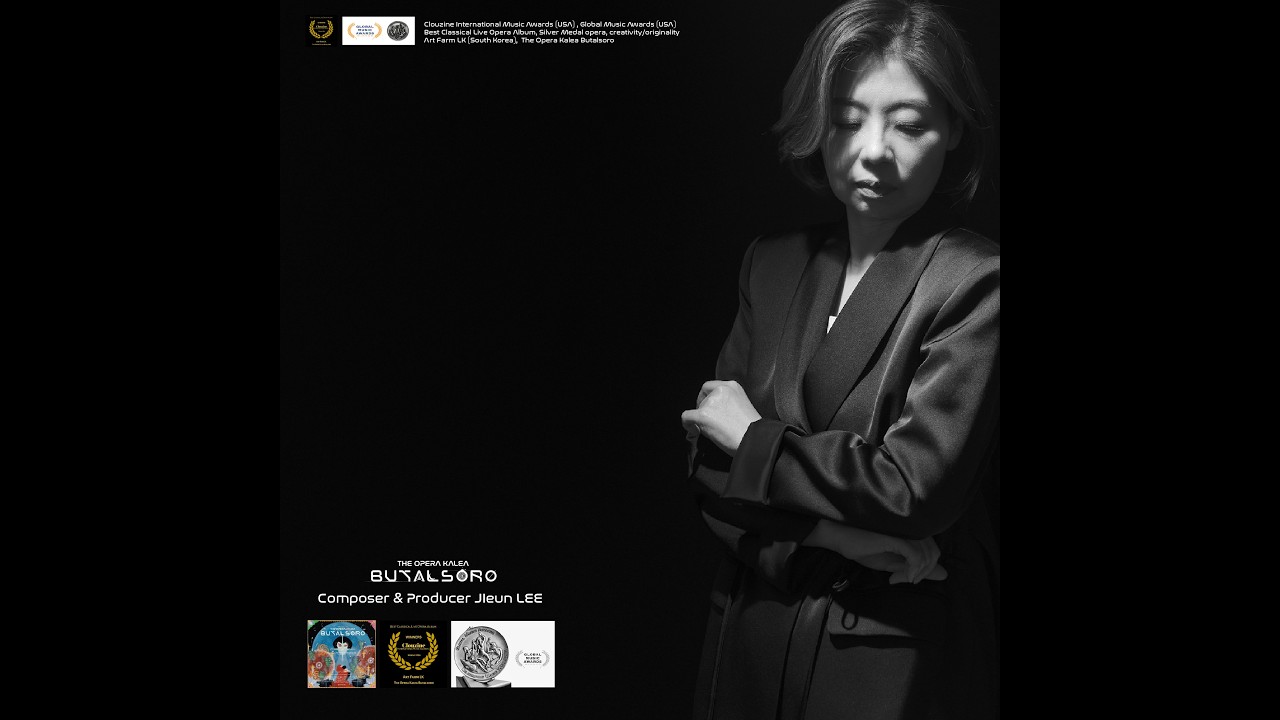
composer Jieun LEE's OPERA KALEA BUTALSORO Live album introduction

Album-Einführung : visionäre Klangreise OPUS KLASSIK 2026 fyc OPERA KALEA BUTALSORO Live album
National Grant and support Selected Works (for its World Premiere)
2025
2023
2022
Opera KALEA – BUTALSORO (115 min.) - (Selected for the "ARCO Selection:Best New Opera" by the Arts Council Korea-2024)
Oratorio Martyres (100 min.) - (Selected for the "Best Original Musical Repertoire" by the Seoul Foundation for Arts and Culture (SFAC)
Cantata First Love (35 min.)
Cantata The Foundation Stone (40 min.)
Opera Time Cobweb (150 min.) - (Selected for the "ARCO Selection:
Best New Opera" by the Arts Council Korea-2021)
Digital Albums
2026
Albums for the Ocean Initiative Series Global digital release by NAXOS Music (Composed by Jieun Lee)
Monologue on the Wave performed by Seunghee Lee (Haegeum)
Deep Susurrus performed by Hyoyoung Kim (Saenghwang)
Ocean Sisu performed by Changsun Lee (Daegeum)
2025
THE OPERA KALEA – BUTALSORO (Live)
Aquarius Quantum: On a Theme from THE OPERA KALEA
2024
Initiative by classical music artists to respond to the climate crisis (Composed by Jieun Lee)
Breezing Piano, Dying Ocean performed by Jueun Grace Kim
On the Sea Cliff performed by Kyungmi anna Lee
The Legend of the Labyrinth: Across Antarctica performed by Jueun Kim
2023
Irresistible Scent of Oratorio Martyres
Pie Jesu Domine Oratorio Martyres
Into the Time Cobweb
Oratorio Martyres: World Premiere, Acts I & II (Live) The Shrine of Music (Original Soundtrack)
Cantata: The Foundation Stone (Live)
2022
My Dear Uigwe
The Story of Uigwe
Time Ghost: Immersive Sound Opera
For Oegyujanggak Uigwe
Publications / Scores
Vocal Score for the World Premiere of the Opera KALEA – BUTALSORO, Act I (2025)
Vocal Score for the World Premiere of the Opera KALEA – BUTALSORO, Act II (2025)
Score for the World Premiere of the Oratorio Martyres, Act I (2023)
Score for the World Premiere of the Oratorio Martyres, Act II (2023)
Vocal Score Opera Time Cobweb – Highlights (2022)
Awards & Honors
2026
Apollo Global Music Awards Winner, Best Composition Opera KALEA BUTALSORO
Neum Underwater Film Festival Orca we remember
Best Original Music Orca we remember
(Director Jae Chung Kim, Composer Jieun Lee)
Marin County Fair International Festival of Short Film Video, California, USA
Environmental 3rd, festival awards Orca we remember
(Director Jae Chung Kim, Composer Jieun Lee)
Clouzine International Music awards (USA) Best Classical Live Opera Album,
OPERA KALEA BUTALSORO Best live Album
Global Music Awards(USA) Silver medal
The Opera Kalea Butalsoro, opera, creativity/originality
(OPERA KALEA BUTALSORO live Album)
2025
Korea Opera Award Best world premiere – Opera KALEA -BUTALSORO
AOA International Awards
Composer Award for Opera KALEA – BUTALSORO2025
New York Classical Music Competition (4th Edition) 1st Prize
(Professional Category – Original Composition)
Max Bruch International Music Competition
Platinum Prize - Opera KALEA – BUTALSORO
(in category Musical Theatre/Opera & Original Composition)
Carl Reinecke International Music Competition
Opera Grand Prize — Opera KALEA – BUTALSORO
(Grand Prize in category Musical Theatre/Opera & Original Composition)
Vivaldi International Music Competition
Grand Prize for Best Choral Work & Best Composer Award
Oratorio Martyres
Ji Eun LEE — Komponistin
Ji Eun Lee komponiert großformatige Musiktheaterwerke, in denen Narration aus musikalischer Struktur und Klang entsteht.
KÜNSTLERBIOGRAFIE
Jieun LEE (*1974) ist eine Komponistin, deren Schaffen sich auf musikalische Großformen, insbesondere Oper und Oratorium, konzentriert. In diesen Formen untersucht sie die Beziehungen zwischen Musik und Narration, das menschliche Erinnern sowie gesellschaftliche und ökologische Fragen der Gegenwart. Auf der Grundlage ihrer musikalischen Erfahrungen in Korea und Deutschland hat sie eine eigenständige Musiksprache entwickelt, die Traditionen der westlichen klassischen Musik, zeitgenössische Klangkonzepte, koreanische Sensibilität und die erzählerische Unmittelbarkeit von Musiktheater und populärer Musik miteinander verbindet.
In Lees Musik ist Narration keine Geschichte, die der Musik von außen auferlegt wird, sondern entsteht aus der musikalischen Struktur und ihrem zeitlichen Verlauf. Die Gesangslinien dienen nicht allein dem Ausdruck der Figurenpsychologie, sondern bilden strukturelle Achsen, die den zeitlichen Fortgang der Musik gestalten. Die Orchestrierung wiederum schafft Atem, Raum, Dichte und Kontinuität. Wiederholung und Schwebezustände fungieren als formale Mittel, durch die sich Erinnerung verdichtet und Zeit ausdehnt. Auf diese Weise geht Musik über ihre Funktion als Hintergrund des dramatischen Geschehens hinaus und wird zu einer Sprache, in der sich die Erzählung selbst konstituiert.
Ihre früheren Werke setzen sich mit historischer Gewalt, Verlust und Erinnerung auseinander. In Werken wie der Oper Time Cobweb und dem Oratorium Martyres untersucht sie, wie individuelle und kollektive Erfahrungen im Laufe der Zeit erinnert und rekonstruiert werden. Diese Auseinandersetzung setzt sich in OPERA KALEA – BUTALSORO fort, wo sich ihr künstlerischer Blick auf das Verhältnis von Mensch und Natur, auf Überleben und Vertreibung, die Klimakrise und ökologische Ethik erweitert. In KALEA – BUTALSORO werden die Realitäten des Meeresspiegelanstiegs und der klimabedingten Vertreibung in eine mythische Erzählung überführt. Der Ozean erscheint dabei nicht lediglich als Schauplatz, sondern als aktive Präsenz, die Erinnerung, Emotionen und die Bedingungen des Überlebens in sich trägt. Nonverbale Elemente wie Wellen, Atem und Stille werden in die musikalische Struktur aufgenommen, sodass Musik nicht bloß der Darstellung einer Szene dient, sondern selbst zu einem Erfahrungsraum wird.
Seit 2025 wirkt Lee an offiziell anerkannten Projekten der UN-Ozeandekade mit und seit 2026 zudem an Projekten, die im Rahmen der Blue-Thread-Initiative der UNESCO-IOC offiziell anerkannt sind. Als künstlerisches Mitglied des ODTIF (Ocean Data Tapestry International Forum) arbeitet sie mit Fachleuten aus Wissenschaft, Bildung und Politik zusammen. Mit Vorträgen auf internationalen Foren und wissenschaftlichen Veranstaltungen zu Ocean Literacy und zur Meeresumwelt untersucht sie, wie wissenschaftliche Erkenntnisse und Daten durch künstlerische Sprache neu interpretiert und in sinnliche Erfahrungen überführt werden können. In ihrer kontinuierlichen künstlerischen Arbeit erforscht sie das Potenzial der Kunst als Sprache der Empathie und Verständigung, die unsere Wahrnehmung der Beziehung zwischen Menschheit und Ozean verändern kann. Mit neuen Opern- und Oratorienprojekten, die den Ozean ins Zentrum stellen, erweitert sie ihre künstlerische Praxis fortwährend an der Schnittstelle von Kunst, Wissenschaft, Bildung und Gesellschaft.
Für Lee ist Musik nicht lediglich ein Mittel, um etwas zu erklären oder zu vermitteln. Sie ist ein Raum, in dem wir die Welt wahrnehmen und erinnern, unsere eigene Position überdenken und unsere Beziehungen zu anderen sowie zur Welt um uns herum reflektieren. Durch Opern und musikalische Großformen bringt sie gesellschaftliche und ökologische Fragen der Gegenwart in die Strukturen musikalischer Zeit und Form ein. Dabei sucht sie beständig nach neuen Beziehungen zwischen Kunst und Leben sowie zwischen Menschheit und Natur.


